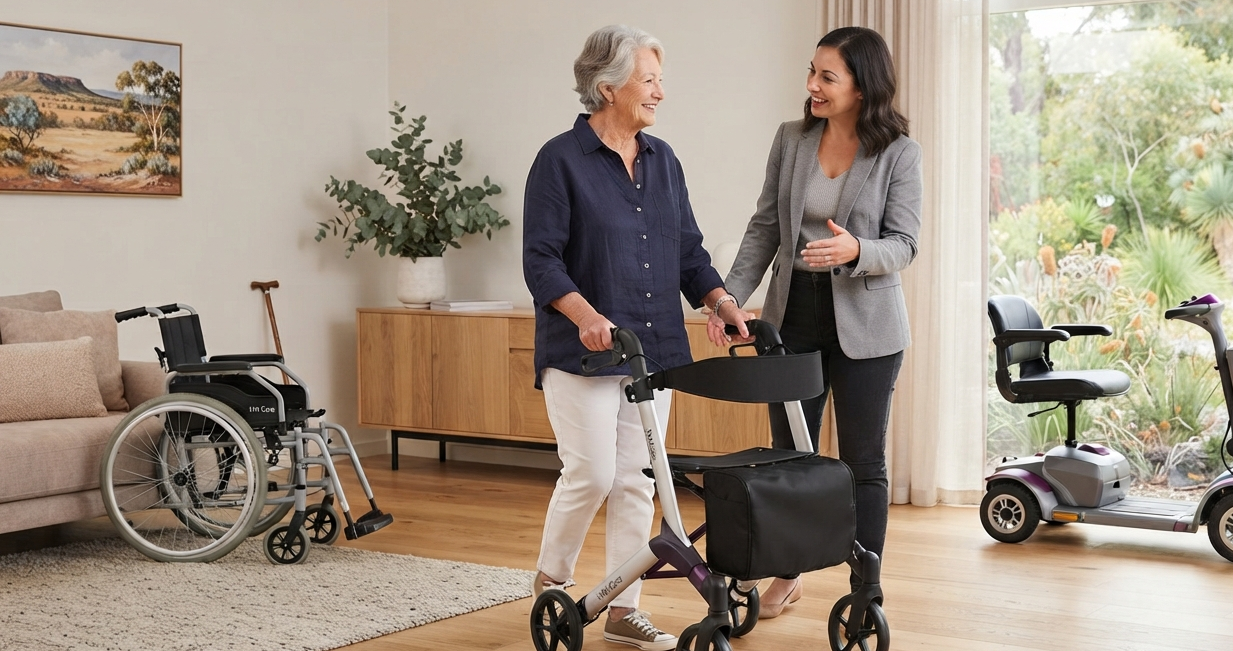
Mobility Aids Australia is the focus of this guide for people who want safer movement, greater comfort and more independence at home and in the community. Whether you are living with disability, recovering from surgery, managing arthritis or experiencing age-related mobility changes, the right equipment can make everyday activities easier.
At HW Care, we understand that no single mobility product suits everyone. Therefore, the right choice should reflect the person’s abilities, living environment, lifestyle and personal goals.
In addition, this Mobility Aids Australia guide covers walking aids, wheelchairs, mobility scooters, bathroom equipment, adjustable beds and daily living products. As a result, you can compare the most common options before speaking with a healthcare professional.
Quick answer: Common mobility aids include walking sticks, walking frames, rollators, wheelchairs, mobility scooters, lift recliner chairs, transfer aids, bathroom safety products, adjustable beds and daily living aids.
Why Mobility Aids Australia Matter for Daily Life
Reduced mobility can affect much more than walking. For example, it may make it harder to prepare meals, shower, shop, attend appointments or participate in social activities.
Consequently, appropriately selected mobility equipment may help people:
- Improve balance and stability
- Reduce fatigue during everyday activities
- Reduce unnecessary strain on muscles and joints
- Move more confidently indoors and outdoors
- Participate in family and community activities
- Complete personal-care tasks more independently
- Reduce some physical demands placed on carers
However, simply owning a mobility aid does not automatically make movement safer. The equipment must be the correct size, adjusted properly and suited to the user’s physical abilities.
Therefore, correct product selection, fitting and training are essential.
Who Can Benefit from Mobility Aids Australia?
Mobility aids may support older people, people with disability, people recovering from injury and those living with chronic health conditions.
In particular, they may be helpful for someone experiencing:
- Reduced balance or stability
- Muscle weakness
- Joint pain or arthritis
- Fatigue while walking
- Difficulty standing from a chair
- Recovery after surgery
- Age-related mobility changes
- Difficulty walking longer distances
- Reduced confidence outdoors
Nevertheless, mobility needs can change over time. For this reason, a physiotherapist, occupational therapist or other qualified healthcare professional should assess more complex needs.
The Australian Government’s Healthdirect mobility aids guide also provides general information about selecting and using mobility equipment.
How to Choose Mobility Aids Australia Products
Before buying equipment, first consider how much physical support the person needs.
For example, someone with mild balance concerns may only require a walking stick. In contrast, a person who needs greater stability may benefit from a walking frame or rollator.
Next, review the home and community environment.
Consider:
- Doorway widths
- Hallway space
- Floor surfaces
- Steps and ramps
- Bathroom dimensions
- Turning space
- Storage areas
- Vehicle access
- Outdoor paths
Furthermore, equipment intended for outdoor use may not work well inside a small home. Similarly, a wide walking frame may not fit safely through narrow doorways.
Comfort is also important. Therefore, check:
- Handle height
- Seat height and width
- Weight capacity
- Back support
- Cushioning
- Brake access
- Footrest position
- Ease of steering
Where possible, trial the product before purchasing it.
Finally, think about the person’s normal routine. If they travel regularly, a lightweight or folding product may be more suitable. On the other hand, if they mainly need support at home, manoeuvrability may be more important than battery range.
When comparing Mobility Aids Australia products, focus on safety, fit and everyday usability rather than price alone.
Top 10 Mobility Aids Australia Residents Commonly Use
1. Walking Sticks
Walking sticks are often the first option considered when a person requires mild walking support.
They are generally lightweight, portable and suitable for many indoor and outdoor environments.
For example, a walking stick may help someone experiencing:
- Mild balance changes
- Arthritis
- Joint discomfort
- Reduced walking confidence
- Weakness on one side
- Recovery after injury
However, the walking stick must be the correct height. Otherwise, it may affect posture or place unnecessary strain on the wrist and shoulder.
In addition, the rubber tip should be inspected regularly and replaced when worn.
Explore HW Care’s range of walking aids.
2. Walking Frames
Walking frames usually provide more support than a walking stick because they create several points of contact with the ground.
Therefore, they may suit people who require greater stability while moving over short distances.
Some walking frames have no wheels, while others have wheels at the front. As a result, the correct model depends on the person’s strength, coordination and walking pattern.
Walking frames may be useful:
- During rehabilitation
- Following surgery
- When balance has declined
- When lower-limb strength is reduced
- For short-distance indoor movement
Nevertheless, correct height adjustment and walking technique remain important.
3. Rollators
Rollators are wheeled walking aids that commonly include hand brakes, a seat and a storage basket.
Because they roll rather than needing to be lifted, they may be easier to use over longer distances.
In addition, the built-in seat allows the user to rest when needed. However, the person must be able to control the rollator and operate its brakes safely.
Before sitting down, the brakes should always be engaged.
Moreover, consider:
- Wheel size
- Frame weight
- Seat height
- Weight capacity
- Folding design
- Storage options
4. Wheelchairs
Wheelchairs can support people who cannot walk safely or who experience significant pain and fatigue over longer distances.
Common options include:
- Transit wheelchairs
- Self-propelled wheelchairs
- Lightweight wheelchairs
- Heavy-duty wheelchairs
- Powered wheelchairs
- Tilt-in-space wheelchairs
The correct wheelchair should match the user’s body measurements, posture, pressure-care needs and daily activities.
Therefore, people who use a wheelchair for extended periods may require a professional seating assessment.
A suitable wheelchair can improve community participation. However, a poorly fitted wheelchair may cause discomfort and make movement more difficult.
Explore HW Care’s range of wheelchairs.
5. Mobility Scooters
Mobility scooters are often suitable for people who can walk short distances but need assistance travelling further.
For example, they may be used for:
- Shopping
- Medical appointments
- Community outings
- Visiting family and friends
- Travelling through large public spaces
- Outdoor recreation
Before selecting a scooter, consider:
- Battery range
- Turning circle
- Ground clearance
- Storage space
- User weight
- Seat comfort
- Intended terrain
- Transport requirements
In addition, the user must be able to operate the steering, brakes and controls safely.
Compact scooters are usually easier to transport. Conversely, larger scooters may provide greater comfort, stability and battery range.
Explore HW Care’s range of mobility scooters.
6. Lift Recliner Chairs
Lift recliner chairs use an electric mechanism to raise and tilt the seat.
As a result, they can reduce the effort required to move from sitting to standing.
These chairs may help people with:
- Arthritis
- Reduced leg strength
- Joint discomfort
- Limited mobility
- Post-surgery restrictions
- Difficulty standing from low chairs
Furthermore, adjustable reclining positions can improve comfort while resting, reading or watching television.
However, chair size matters. A seat that is too deep, too high or too low may make transfers more difficult.
Therefore, check the user’s height, leg length, seat width and required weight capacity before purchasing.
Explore HW Care’s range of lift recliner and supportive chairs.
7. Transfer Aids
Transfer aids help a person move between surfaces, such as from a bed to a wheelchair or from a chair to a toilet.
Common transfer aids include:
- Transfer boards
- Transfer belts
- Standing aids
- Turning devices
- Transfer platforms
- Patient lifters
Because transfers can involve a higher risk of injury, the equipment must suit both the user and the person assisting them.
Moreover, family members and carers may need training in the correct technique.
For complex transfers, seek advice from an occupational therapist or physiotherapist. Consequently, both the user and the assisting person can complete transfers more safely.
8. Bathroom Safety Equipment
Bathrooms can be challenging because they often contain wet surfaces, hard flooring and limited turning space.
Therefore, bathroom safety products may help people complete personal-care activities with greater confidence.
Useful products include:
- Shower chairs
- Shower stools
- Grab rails
- Raised toilet seats
- Over-toilet aids
- Toilet safety frames
- Non-slip mats
- Bath-transfer equipment
In addition, these products may reduce the effort required for showering, toileting and standing.
However, grab rails must be correctly positioned and securely installed. For this reason, professional advice may be necessary when making permanent bathroom modifications.
Explore HW Care’s range of bathroom safety equipment.
9. Adjustable Beds
Adjustable beds allow the user to raise the head, legs or overall sleeping position.
Consequently, they may make repositioning, resting and getting out of bed easier.
Depending on the user’s needs, an adjustable bed may support:
- Easier bed transfers
- More comfortable positioning
- Reduced physical effort
- Improved access for care activities
- Greater independence in the bedroom
Nevertheless, the mattress and accessories must be compatible with the bed.
If bed rails or other attachments are being considered, first assess their potential risks. In particular, these accessories should not be added without understanding how they may affect movement and safety.
10. Daily Living Aids
Daily living aids are practical products that make routine activities easier.
For example, they may include:
- Reachers and grabbers
- Sock aids
- Dressing sticks
- Button hooks
- Long-handled shoehorns
- Jar and bottle openers
- Adapted cutlery
- Tap turners
- Long-handled sponges
These products may be especially helpful for people with arthritis, reduced flexibility or limited hand strength.
Although they are often simple, they can make a meaningful difference to everyday independence.
Explore HW Care’s range of daily living aids.
Can the NDIS Fund Mobility Aids Australia Products?
The NDIS may fund some assistive technology when it relates to a participant’s disability, supports their goals and meets current NDIS funding criteria.
However, funding is not automatic.
The NDIA may consider whether the support:
- Relates to the participant’s disability
- Supports the participant’s goals
- Is likely to be effective and beneficial
- Represents value for money
- Is an eligible NDIS support
- Is appropriately funded by the NDIS
- Has suitable supporting evidence
The amount of evidence required may depend on the cost, complexity and risk of the equipment.
For example, some low-cost and low-risk products may require less supporting information than customised or higher-risk equipment.
Therefore, participants should check their plan and speak with their NDIS contact, plan manager or allied health professional before purchasing equipment with NDIS funding.
Read the official NDIS assistive technology information.
Mobility Equipment Safety and Maintenance Tips
Correct use is just as important as selecting the right product.
Therefore, always follow the manufacturer’s instructions and arrange appropriate training where required.
In addition:
- Check brakes, wheels and tyres regularly.
- Replace worn rubber tips.
- Keep pathways free from clutter.
- Remove loose rugs and electrical cords.
- Wear supportive, non-slip footwear.
- Charge powered equipment as directed.
- Never exceed the stated weight capacity.
- Keep equipment clean and dry.
- Arrange servicing when recommended.
- Seek reassessment if mobility needs change.
For this reason, reputable Mobility Aids Australia suppliers should provide clear product specifications, instructions and appropriate support.
Likewise, stop using equipment that causes pain, poor posture, instability or difficulty completing normal movements.
Frequently Asked Questions About Mobility Aids
What is the best mobility aid for seniors?
There is no single best mobility aid for every older person.
Instead, the correct product depends on the person’s balance, strength, health, home environment and daily activities. Therefore, professional advice is recommended when mobility needs are complex.
What is the difference between a walker and a rollator?
A walker or walking frame generally provides stable support and may need to be lifted or moved forward in small steps.
In contrast, a rollator has wheels and brakes and often includes a seat. Consequently, it may be easier to use over longer distances.
Should I choose a wheelchair or mobility scooter?
A wheelchair may be more appropriate for someone who requires ongoing seating support or cannot walk safely.
On the other hand, a mobility scooter may suit someone who can walk short distances but needs powered assistance for longer journeys.
Can mobility aids prevent falls?
Mobility aids may improve stability when correctly selected, fitted and used.
However, they cannot prevent every fall. Therefore, they should be combined with clear pathways, suitable footwear, appropriate health reviews and strength or balance support where recommended.
Are mobility aids covered by the NDIS?
Some products may be funded when they meet NDIS requirements and relate to the participant’s disability and goals.
Nevertheless, eligibility depends on the participant’s individual circumstances, available plan funding and supporting evidence.
Should I speak with an occupational therapist or physiotherapist?
Professional advice is particularly important when someone has complex mobility needs, requires customised equipment or is considering a higher-risk product.
Occupational therapists commonly assess daily activities and home environments. Meanwhile, physiotherapists commonly assess strength, movement, balance and walking.
How often should mobility equipment be serviced?
Service intervals vary depending on the product and manufacturer.
However, equipment should be inspected regularly. Furthermore, it should be serviced whenever brakes, steering, batteries, wheels or moving parts are not working correctly.
Choose Mobility Equipment with Confidence
Choosing suitable equipment can improve comfort, confidence and participation.
However, the best option is not always the most expensive or technically advanced product. Instead, it is the product that safely matches the individual’s abilities, environment and personal goals.
This Mobility Aids Australia guide provides a practical starting point for comparing common products. Nevertheless, professional assessment remains important when someone’s needs are complex, changing or associated with higher risks.
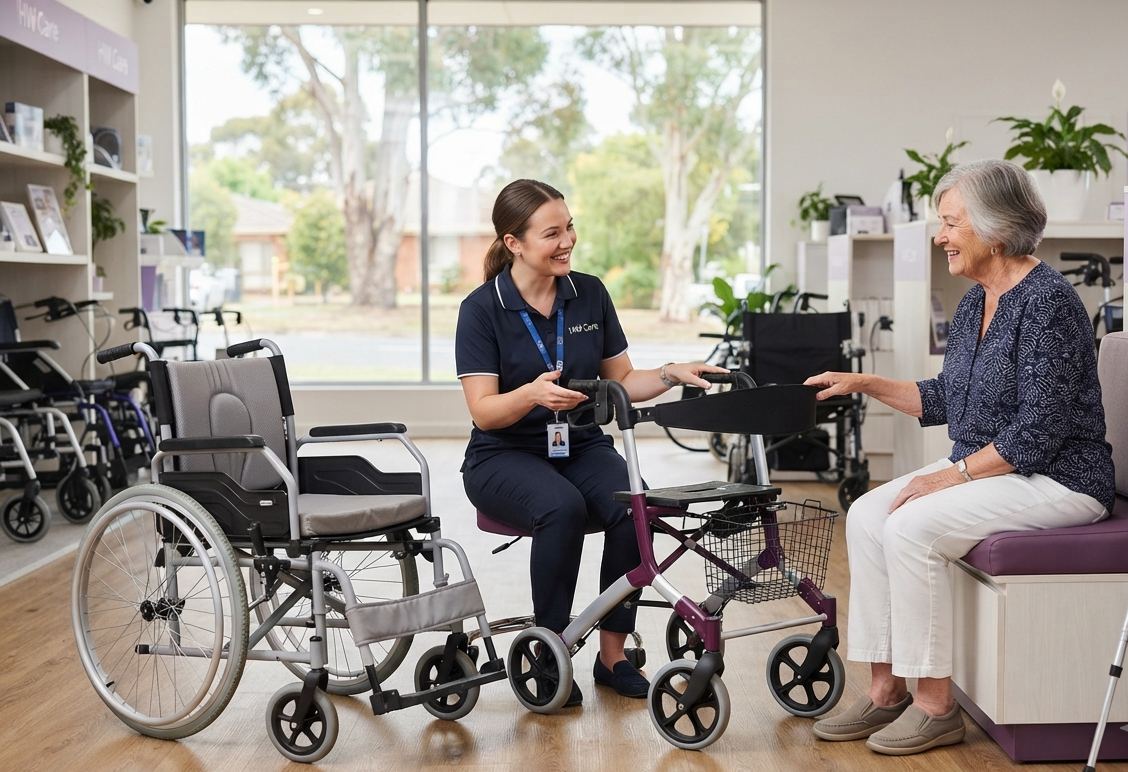
At HW Care, we help Australians explore practical products for mobility and independent living. Therefore, customers can compare walking aids, wheelchairs, mobility scooters, bathroom equipment and daily living aids in one place.
Explore HW Care mobility and independent living products or contact the HW Care team for product assistance.
This article provides general information only and does not replace individual medical, allied health or NDIS advice.